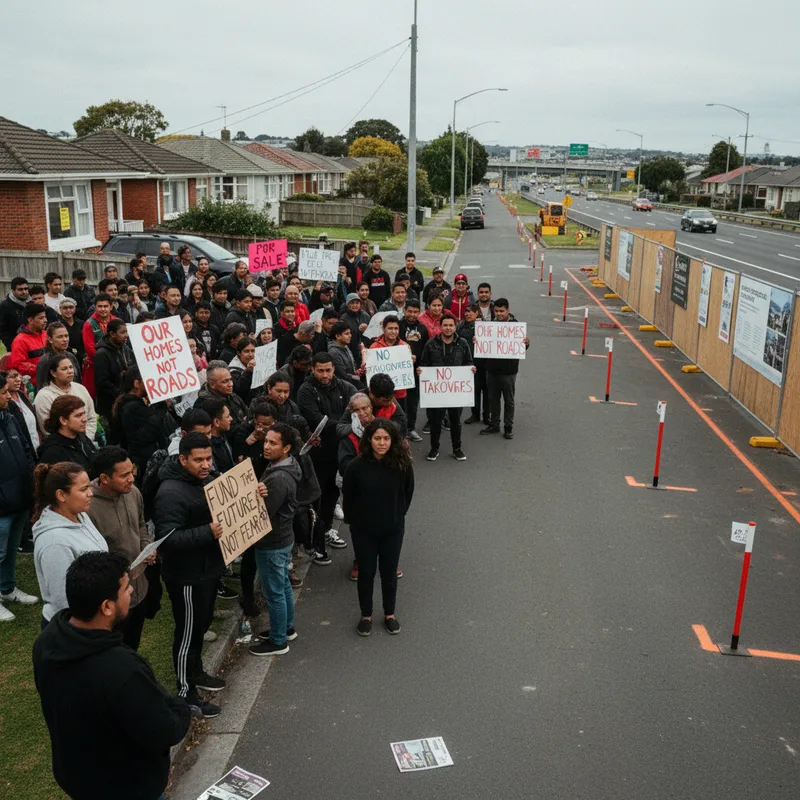
Anxiety and uncertainty are shadowing hundreds of homeowners in South Auckland after Auckland Transport (AT) confirmed the protected route for its Airport to Botany rapid transit project. Up to 630 properties lie in the path of the proposed 15km busway, which will cut through the airport precinct, Papatoetoe, Manukau, and East Auckland, leaving residents in a protracted state of limbo.
For John Hansford, his brick and tile house on Puhinui Road in Papatoetoe is more than just property; it's the heart of his family's history. He and his wife have lived there for over 50 years, raising their children and two grandchildren within its walls. The garden, a source of immense pride, is the main reason he has never wanted to leave.
"Look at the garden, I mean, that's why I live here… that's why I don't move," Hansford says. "I'm 76 now, so I don't really want to move."
His home is one of an as-yet-unidentified number that will be completely removed to make way for the project's widened roads, dedicated bus lanes, and walking and cycling paths. While the route is now protected, the crucial design and construction phases are not funded, with AT not expected to seek funding until at least 2028. This prolonged uncertainty is what Hansford calls an "aggravation" he doesn't need. "This started in 2021, it's five years, [it] ain't doing my health any good," he says.
A 'real shock' for residents
While Auckland Transport will eventually purchase the required properties under the Public Works Act 1981, Hansford is deeply sceptical that any payout will be enough to buy a comparable home in the area he has known for a lifetime. "When you've lived here for more than 50 years… where would you go from here?" he asks. "There's nothing around Papatoetoe that I could afford these days."
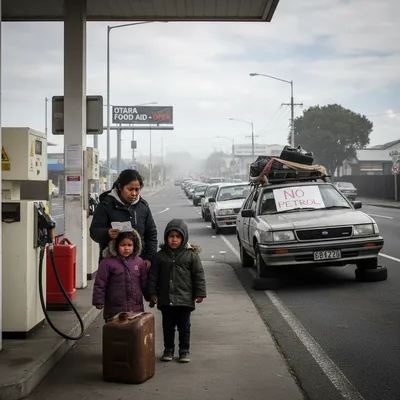
This financial anxiety is shared by many in the community, where the rising cost of living continues to bite. For some, the pressure of high fuel prices already strains household budgets, making the thought of an involuntary, under-compensated move even more daunting.
Fellow Puhinui Road resident Heather Haylock shares a similar story of deep roots. She and her husband moved into their bungalow 29 years ago. Over three decades, they transformed it, adding improvements, planting trees, burying beloved pets, and even building a dedicated "writing lair" in the backyard for Haylock, a children's author. Despite these connections, they have decided to move in a few years, but the route protection now casts a long shadow over their financial future. "We're a bit concerned about the resale and how that will go," she says.
The initial communication from Auckland Transport caused significant distress. Haylock says they attended a one-on-one meeting believing only a few metres of their land were needed. The reality was a bombshell.
We found out right at the end when we said, 'So how much of our property is actually affected?' And they said, 'Oh, we want the whole thing.' So that was a real shock.
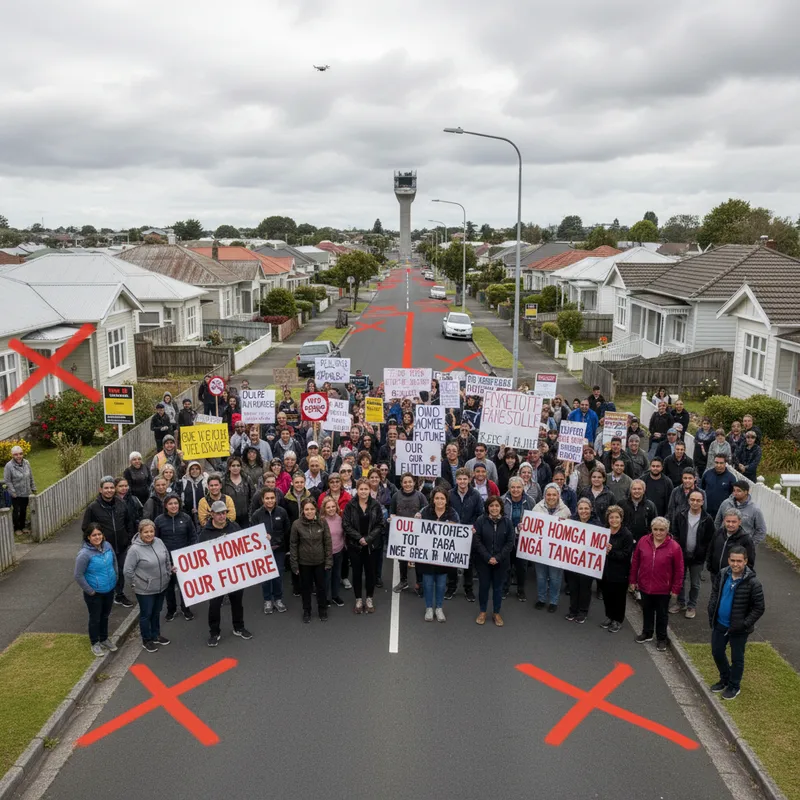
Compounding their shock was a lack of transparency. When the Haylocks asked to see a map of the entire route to understand the project's full scope, they were refused. "They said that they weren't able to show us that because they could only talk to us about our land and not about how it would impact anybody else's land," she recalls. This secrecy spurred the community into action, with the Haylocks going door-to-door, "trying to look at everybody else's letters to make our own map".
'A process for nothing'
With a background in town planning, Haylock took a stand, lodging a detailed 20,000-word submission to the independent commissioners hearing concerns about the project in 2023. Her primary concern shifted from her own property to the broader community impact, particularly on those whose homes bordered the project.
"The only people who were actually given a letter to say anything was happening were the people whose properties would be bought under the Public Works Act," Haylock explains. "People like across the road and the neighbours at the back, who will have a huge bridge going through, overshadowing them, weren't deemed to be affected, because their properties weren't being bought, so they weren't consulted at all."
Papatoetoe is a vibrant, established suburb with a strong sense of community, home to a significant and growing number of residents of Indian descent. This lack of broad consultation has been felt deeply in a community that has previously come together to confront challenges with a united voice.
Although the commissioners made recommendations that Haylock felt would benefit the community, she was left feeling disillusioned. "Auckland Transport, as a designating authority, doesn't actually need to take on board anything that the independent commissioners said," she says. "So it really did feel like we were going through a process for nothing."
Following AT and NZTA lodging their decisions in February 2024, 13 appeals were filed in the Environment Court by major entities like Auckland International Airport, AUT, and Z Energy. However, no individual residents appealed. John Hansford considered it but was deterred by the $600 application fee, highlighting the financial barrier for ordinary citizens to challenge powerful authorities.
Project timeline remains uncertain
All 13 appeals have now been resolved, and the designations protecting the route are set to last for 15 years. For now, the next tangible step is a $52 million project to make "interim" improvements by extending the existing Airport Link bus service from Manukau to Botany. This work is funded and expected to occur around 2028, and crucially, will not require any property acquisitions. However, the main event, the construction of the full busway, remains a distant prospect. The project has been listed for the government's fast-track consenting process, but AT has confirmed that lodging for consent requires detailed design work, which in turn requires funding that it does not have. This funding uncertainty follows closely on the heels of a past example where Auckland lost its 2027 SailGP bid after the government rejected a funding request.
This leaves residents like John Hansford and Heather Haylock in a painful state of suspension. They are tied to homes they may be forced to leave, unable to sell for a fair price, and with no clear timeline on when their fate will be decided. The situation highlights a major challenge for Auckland as it pushes forward with large-scale infrastructure projects, similar to funding debates that recently saw the city lose a major sporting event.
For the residents of Puhinui Road and the hundreds of others along the 15km route, the promise of progress feels more like a threat. Haylock's advocacy was driven by a concern for those who would be most affected. "We knew that more than likely we wouldn't still be here when it went through, but it was more the people who were left behind that we were more concerned about," she says.