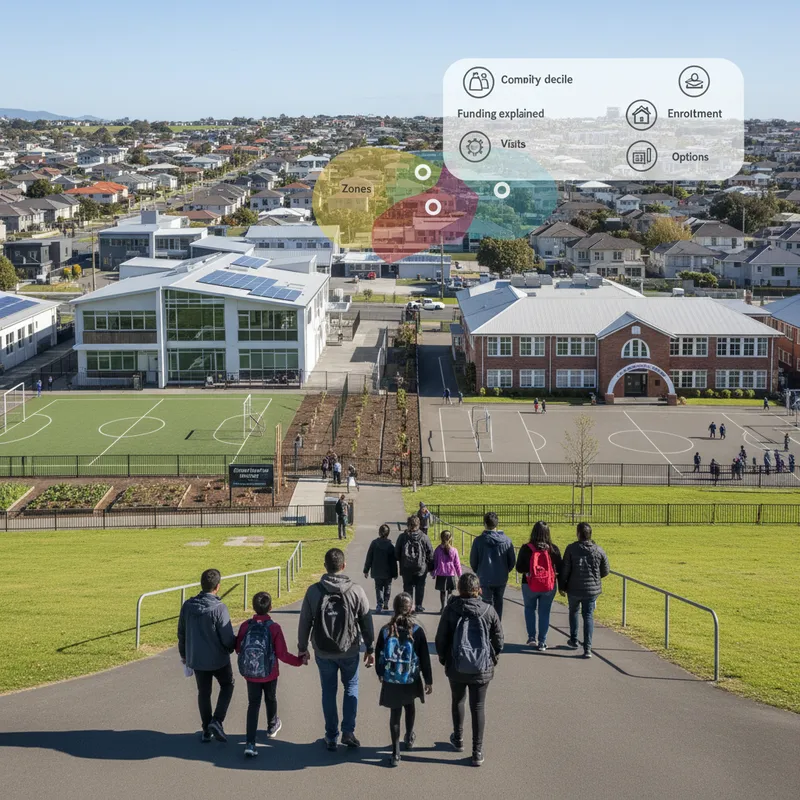
Choosing a school in Papatoetoe and Ōtara can feel like trying to solve three problems at once, finding a good learning fit for your child, understanding enrolment zones, and making sense of old labels like “deciles” that are still used in everyday conversation even though the system has changed.
This 2026 guide is written for parents, whānau, caregivers and new-to-Auckland families comparing local schools across Papatoetoe and Ōtara, including state, state-integrated and special character options. It is not a ranking. It is a practical way to narrow your shortlist, check whether you are in zone, and ask better questions on school visits.
Two quick notes before you start. First, school information changes, rolls shift, principals move, and zones can be updated. Always confirm the latest details with the school and the Ministry of Education (MoE). Second, if you are making a housing decision based on a zone, double-check street numbers, not just street names, because some zones use odd or even number ranges.
How school zones work in Papatoetoe and Ōtara in 2026
Most state schools in South Auckland use enrolment zones to manage roll growth. If you live “in zone”, your child has a right to enrol. If you live “out of zone”, you may only be offered a place if the school has room, usually via a ballot.
The MoE explains the legal framework for enrolment schemes (including zones) and the priority order for out-of-zone places. Start here for the official rules: Ministry of Education, enrolment schemes.
In Papatoetoe, zones can be tight and street-number specific. That matters if you are renting, moving, or living on the border of two zones. Always ask the school office for written confirmation that your address is in zone before you rely on it for enrolment.
Practical tip: If you are in temporary accommodation, ask the school how it treats “usual residence” versus a short-term address. Schools often require evidence such as a tenancy agreement, utility bill, or statutory declaration.
Check if you are in zone, street lists you can verify
The fastest way to begin is to check your address against official zone documents or zone maps.
- Use Education Counts to find schools: the MoE’s directory is a solid starting point for the Ōtara-Papatoetoe area list, including profiles and contact details: Education Counts, schools in Auckland, Ōtara-Papatoetoe.
- Use the NZ school enrolment zones map dataset: zone boundaries are available as a public layer via Eagle Technology’s Esri-hosted dataset used by MoE: NZ school enrolment zones (ArcGIS).
For families in central Papatoetoe, Papatoetoe Central School has a zone list that is very specific by street and, in some cases, by number ranges. The following streets and number rules are included in the 2023 zone list available publicly: Great South Road (even 2 to 454, odd 1 to 435, plus “all 707 to 7” as shown on the document), East Tamaki Road (numbers 21 to 139), Carruth Road (even 22 to 76, odd 23 to 59), Kingswood Road (even 84 to 176, odd 1 to 435), Maxwell Avenue (even 266 to 284, odd 279 to 293), Seymour Avenue (even 100 to 248, odd 111 to 267), Sutton Crescent (even 20 to 50, odd 9 to 63), plus many streets listed as “all”, including Birdwood Avenue, Butler Avenue, Central Avenue, Glen Avenue, Grange Road, Kolmar Road, St George Street, Tui Road, Victory Road and others.
Why this matters: it is common for two houses on the same street to fall in different zones if only certain number ranges are included.
Papatoetoe South School also publishes an in-zone street list on its website, including Abelia Place, Cambridge Terrace, Chestnut Road, Puhinui Road (from 186 to end, and 193 to end), Hillside Road (55 to end and 72 to end), and Roscommon Road (up to Wiri Station Road), among others. Use the school’s zone page for the latest list: Papatoetoe South School, school zone.
Papatoetoe High School also provides an in-zone streets resource and downloadable PDF on its site: Papatoetoe High School, in school zone streets.
What to do if you are out of zone: ask the school when out-of-zone applications open, how many places are likely in your year level, and how ballots are run. If you are moving house soon, ask whether the school will accept a future in-zone address and what proof is required.
Deciles are gone, what to use instead in 2026
“Decile” was a funding indicator based on the socio-economic characteristics of the communities a school served. It is no longer used for school funding. However, families still hear it in casual conversation, and real estate ads sometimes still mention it.
In 2026, the best replacement questions are not “what’s the decile?” but:
- What learning support is available, and how quickly can it start?
- How stable is staffing, and what is teacher retention like?
- What are the school’s attendance, achievement and wellbeing priorities?
- How does the school partner with whānau, and communicate in multiple languages?
If you do see a decile-like label still referenced online, treat it as outdated. For context, public summaries may still show historic information in various places. For example, the Wikipedia entry for Sir Edmund Hillary Collegiate lists a “socio-economic decile 1A”, reflecting an older system rather than the current funding model. Always use MoE and Education Counts for up-to-date profile information.
Compare schools like a local: what to look for beyond marketing
School websites and prospectuses are important, but they all look similar. On visits, you learn the real differences: how children move around the grounds, how calm classrooms feel, how teachers interact with students, and how the office welcomes families.
Here is a local comparison checklist that works well for Papatoetoe and Ōtara, where schools can differ in size, special character, language support and pathways.
- Learning support: Ask about ORS, RTLB, teacher aide hours, and reading or maths interventions.
- ESOL and multilingual support: Many families in Papatoetoe and Ōtara speak Hindi, Punjabi, Samoan, Tongan, Te Reo Māori and more. Ask how ESOL is delivered and how whānau communication is handled.
- Behaviour and wellbeing: Ask how the school handles restorative practice, stand-downs, and peer conflict, and what supports exist for anxiety and attendance.
- Transitions: For Year 6 to 7, and Year 8 to 9, ask about orientation days, buddy systems, and how learning needs are passed on.
- Co-curricular: Check sports, music, culture groups and leadership opportunities. In South Auckland, cultural performance is a major part of school life for many families, with events such as Polyfest shaping rehearsal commitments and school pride. For local context, see our reporting on community calls for stability in Polyfest funding: ASB Polyfest 51st year: organisers push for stable funding.
Bring a notebook: After three school visits, details blur. Write down what you notice about playground supervision, class sizes, homework expectations and how the school talks about achievement.
Primary schools in Papatoetoe and Ōtara families often shortlist
Below are state and state-integrated primary options that commonly come up when local families are comparing schools. Always confirm enrolment zones, year levels, and whether the school has enrolment pressure in your intake year.
Papatoetoe Central School, Papatoetoe. Zone rules are street and number specific (see earlier section). Website: papatoetoecentral.school.nz (confirm current).
Papatoetoe South School, Papatoetoe. Publishes in-zone streets and maps. Website: Papatoetoe South School.
Papatoetoe West School, Papatoetoe. Website: pap-west.school.nz.
Papatoetoe East School, Papatoetoe. Listed on Education Counts for Ōtara-Papatoetoe district. Check the school’s zone and enrolment process via the school office or profile page.
Papatoetoe North School, Papatoetoe. Also listed on Education Counts, confirm zoning and start dates for new entrants.
Rongomai School (Papatoetoe). Commonly considered by families on the southern side of Papatoetoe, close to Puhinui and Wiri.
Wymondley Road School (Ōtara). Families in Ōtara often compare local contributing schools based on pastoral care, learning support and cultural programmes.
Yendarra School (Ōtara). Another local option listed on Education Counts for the district.
Holy Cross School (Papatoetoe) and St John the Evangelist Catholic School (Papatoetoe) are Catholic state-integrated options. State-integrated schools can have preference criteria and attendance dues. Ask the office for current dues and preference documentation requirements.
Typical hours: Most local primary schools operate roughly 9am to 3pm, with after-school care varying by provider. Confirm exact start and finish times during your visit, especially if you rely on public transport or older siblings walking home.
Costs to ask about: While tuition is free at state schools, you may still have costs for stationery, devices, uniforms (if used), camps, donations or activity fees, and after-school care. Ask for a “costs for the year” sheet.
Intermediate and secondary options, including pathways across campuses
The Papatoetoe and Ōtara area includes both traditional intermediates and combined campus models, plus stand-alone secondary schools.
Papatoetoe Intermediate serves Years 7 to 8 and is a key transition point for many families in central Papatoetoe. Ask about extension programmes, learning support, and how the school supports the jump to NCEA-aligned learning habits at secondary.
Ferguson Intermediate (Ōtara) and Kedgley Intermediate (nearby) are also part of how many local families plan the Year 7 to 10 years. Ask about subject rotation, technology options and pastoral structures.
Papatoetoe High School is a major local secondary option. Because zones matter a lot at secondary level, check the school’s in-zone streets resource before you make assumptions: Papatoetoe High School zone streets.
Aorere College (nearby in Māngere) and Tangaroa College (Ōtara) are also listed in the Ōtara-Papatoetoe district on Education Counts. Families sometimes compare across these boundaries depending on where they live and whether they have in-zone access.
Sir Edmund Hillary Collegiate is a three-school campus in Ōtara (Years 0 to 13 across junior, middle and senior schools), at 2 Franklyne Road, Ōtara, Auckland. Website: sehc.school.nz. A campus model can be appealing for families wanting continuity across transitions, but it is still worth asking how each school within the collegiate operates day-to-day.
De La Salle College is a Catholic state-integrated boys’ secondary in the wider area and appears on the district list. If you are considering state-integrated secondary, ask about attendance dues, uniform expectations and preference criteria early, because paperwork can take time.
How to apply and enrol without missing deadlines
Every school has its own timelines, but the enrolment pattern is fairly predictable. The earlier you start, the less stressful it becomes.
- Shortlist 3 to 5 schools based on location, zone access, learning needs, and values.
- Confirm your address is in zone in writing, especially if the zone list uses number ranges.
- Book a tour during school hours if possible, so you can see real learning time.
- Ask for enrolment pack and dates including out-of-zone ballot dates if relevant.
- Gather documents, typically birth certificate or passport, proof of address, immunisation record (often requested), and any learning support documents.
- Plan the transition, including visits for your child, meeting learning support staff, and transport arrangements.
What if you are new to Auckland or moving mid-year? Tell the school immediately. Rolls can be tight, and mid-year movement is common in South Auckland. Schools will guide you on start dates and what support is available from day one.
Out-of-zone reality check: Even strong applicants can miss out if the school is full. Always have a back-up plan that you are happy with, not just a “last resort”.
What local issues can affect schools, transport, funding and community voice
School choice is not just about classrooms. It is also shaped by the wider neighbourhood, transport reliability, council decisions, and how community organisations are funded.
For example, changes to Auckland Council rates and services can affect household budgets, which in turn shapes choices around after-school care, transport and extra-curricular costs. If you are weighing school costs, it is worth keeping an eye on local reporting about rates and service changes, including: Aucklanders face final call on rates hike and service change and Auckland Annual Plan: feedback open as rates set to rise 7.9.
Local representation can also influence advocacy on issues families care about, from safer crossings near schools to facility upgrades and community services. Our coverage of the Papatoetoe by-election and civic participation gives context for how local decision-making plays out, including Papatoetoe voters urged to prioritise crucial by-election.
Finally, if your whānau is connected to faith or cultural communities, school choice might include proximity to major community events. Papatoetoe regularly hosts large community gatherings, for example the National Hindu Conference set for Papatoetoe on 16 May 2026. These events can influence weekend commitments and social networks that support families during the school years.
Cross-city comparison: If you are relocating within New Zealand and want to compare how school-search works in another city, see this broader guide: 30 unmissable things to do in Christchurch, autumn 2026 guide. It is not a schools piece, but it helps families think about suburb fit, transport and weekend rhythms when moving cities.
A simple decision framework for choosing the right school
After you gather information, the hardest part is turning it into a decision you feel confident about. A simple framework helps.
- Non-negotiables: zone access, learning support, safety, and commute time.
- Strong preferences: language support, cultural programmes, sports, arts, technology, faith character.
- Nice-to-haves: newer facilities, certain electives, particular uniforms, specific friends attending.
Then rate each school you visit against your child’s needs, not the loudest online opinions. Papatoetoe and Ōtara schools serve diverse communities, and the best fit is often the school that partners with your child and your whānau consistently, week in and week out.
On your final visit, ask: “If my child is struggling, what happens in the first two weeks?” The answer will tell you more than any slogan.